

Introduction
Real-time decisions are the ability to capture, unify, decide, orchestrate, and learn from customer interactions in real time, leveraging identity resolution and context-aware decisioning.
At Redpoint, the concept of “real-time” embodies responsiveness, context, and precision. This philosophy is not limited to technological performance but encompasses the ability to engage meaningfully at the precise moment of interaction, regardless of the channel or touchpoint involved.
Real-time engagement is a multifaceted approach that integrates both technical execution and experience design.
-
Technical execution involves the seamless movement and orchestration of data, ensuring that information flows efficiently and effectively to support immediate decision-making and action.
-
Experience design focuses on delivering genuine value at the moment of interaction, creating a user experience that feels intuitive and relevant.
This duality of real-time engagement means that organizations must not only prioritize speed but also consider the context in which their interactions occur. It is about understanding the nuances of each engagement and responding in a way that resonates with the user’s needs and expectations. By combining these elements, Redpoint aims to redefine what it means to operate in real time, ensuring that every interaction is not only timely but also meaningful and impactful.
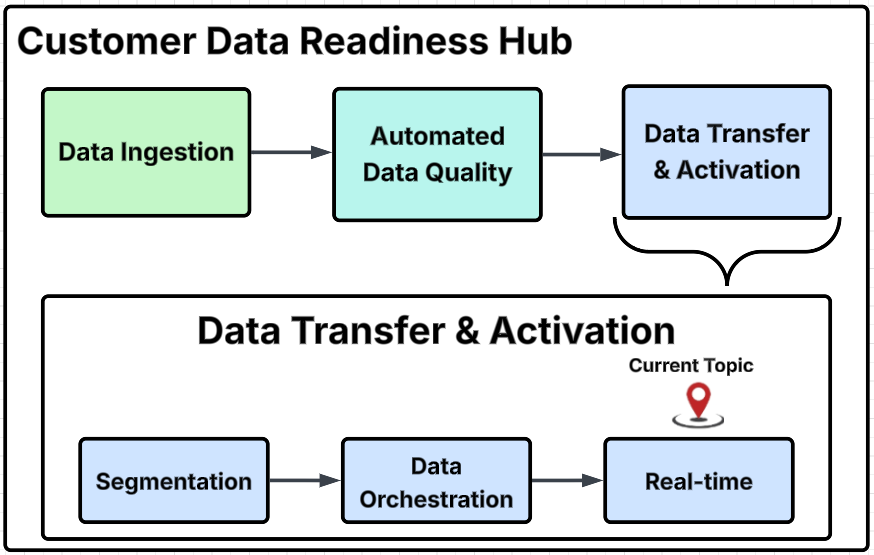
Customer Data Readiness Hub diagram
This diagram outlines the primary process steps within the Customer Data Readiness Hub, provides a detailed breakdown of specific activities within each major group, and identifies the particular step addressed on this page with the "Current Topic" marker.
Core principles of real-time
Data freshness and continuity
Streaming or immediate ingestion of events, behaviors, and updates from various systems of record allows organizations to respond swiftly to changes and trends as they occur. Redpoint places significant emphasis on continuity across time horizons. This means that the most recent event is not viewed in isolation but is contextualized against a backdrop of historical data. Such an approach enables a level of personalization that is not only immediate but also relevant to the user, enhancing the overall experience and engagement.
Identity at the core
Effective real-time orchestration relies heavily on identity resolution, which must be continuously applied to ensure that the interactions and decisions made are grounded in a comprehensive understanding of the individual. A “Golden Record” is essential; it guarantees that actions taken in real-time are based on a unified, accurate, and trusted profile of the customer. Relying on a single, isolated event can lead to misguided decisions that fail to resonate with the customer’s needs and preferences.
Decisioning with context
Real-time engagement means deciding with purpose and insight. Redpoint integrates rules-based logic, machine learning, and business context to determine the next best action or offer in an instant. There is a one-to-one relationship between the request or inbound demand (which could be a call to a call center, web site visit, or other customer-initiated action) and the corresponding real-time response, which is generated based on that individual’s profile, ensuring a seamless customer experience. This approach to context-aware decisioning prevents the occurrence of “fast but irrelevant” responses that could potentially degrade customer trust and satisfaction. By ensuring that decisions are made with a comprehensive understanding of the context, organizations can foster deeper connections with their customers.
Omnichannel activation
For real-time strategies to be effective, they must extend seamlessly across all customer channels, including web, mobile, call centers, point of sale, email, and direct mail. The same decisioning framework should govern actions across all touchpoints, ensuring a consistency of experience that customers have come to expect, regardless of their entry point into the brand’s ecosystem. This omnichannel approach not only enhances customer satisfaction but also builds brand loyalty, as customers feel recognized and valued across all interactions.
Operational reliability
Redpoint's real-time capabilities are an always-on operational standard that is integral to business success. To achieve this, organizations must implement robust monitoring, throttling, retry strategies, and workflow failover mechanisms to ensure resilient execution of real-time processes. By prioritizing operational reliability, businesses can maintain high levels of performance and trust, even in the face of unexpected challenges or fluctuations in demand.
Redpoint’s real-time execution philosophy
-
Capture: This step involves the continuous streaming or polling for events that occur across various systems, including user interactions such as clicks, transaction data, sensor readings, and more. By capturing these events in real time, organizations can gain valuable insights into user behavior and system performance.
-
Unify: In this phase, identity resolution is applied in real time to associate the captured events with known user profiles. This process ensures that each interaction is accurately mapped to the correct individual, allowing for a more personalized experience. By unifying data from different sources, businesses can create a comprehensive view of their customers.
-
Decide: Here, the focus shifts to evaluating various business rules, personalization models, and contextual data to select the best action to take in response to the captured events. By leveraging advanced analytics and machine learning, organizations can make informed decisions that enhance customer engagement and drive better outcomes.
-
Orchestrate: Once a decision has been made, the next step is to deliver the action seamlessly across the appropriate channels to ensure that the chosen response reaches the intended audience effectively, whether through email, mobile notifications, social media, or other communication platforms. The goal is to provide a cohesive experience that resonates with users.
-
Learn: The final step involves capturing response signals from the actions taken for performance reporting and model retraining. By analyzing how users respond to different actions, organizations can refine their strategies, improve their models, and enhance their ability to meet customer needs.
Differentiation in Redpoint’s approach
-
True real time, not batch simulation: Unlike many platforms that claim to offer “real-time” capabilities through accelerated batch processing, Redpoint’s architecture is fundamentally different; it is event-driven and streaming-native, which guarantees true immediacy in data handling and response. This means that users can expect instant feedback and interactions, enhancing the overall user experience.
-
Identity-first decisioning: The real-time responses provided by Redpoint are anchored in the Golden Record of customer data. This approach avoids the pitfalls of fragmented, channel-only personalization that many other systems fall victim to. By using a comprehensive view of the customer, Redpoint ensures that every interaction is relevant and tailored, leading to more meaningful engagements.
-
Composable orchestration: Redpoint’s real-time capabilities are part of a broader orchestration framework that integrates real-time responses with scheduled campaigns, triggered journeys, and AI-driven programs, allowing for a seamless and cohesive marketing strategy. This integration ensures that businesses can leverage real-time data while still executing planned marketing initiatives effectively.
-
Scalable & reliable: Redpoint is designed with enterprise scale in mind, ensuring that it can handle the demands of large organizations. It features configurable Service Level Agreements (SLAs), comprehensive monitoring capabilities, and flexibility in integration. This reliability means that businesses can trust Redpoint to deliver consistent performance even as their needs grow and evolve.
Refer to the Realtime Decision documentation for detailed information about how Redpoint enables real-time decisions.
Business impact of real time
-
Customer experience: Successful businesses create trust and satisfaction among their customers through timely, relevant, and consistent interactions that meet or exceed customer expectations. By focusing on understanding customer needs and preferences, businesses can foster a sense of loyalty and engagement, ensuring that customers feel valued and appreciated throughout their journey.
-
Revenue acceleration: Driving incremental value can be accomplished by recognizing customer intent and swiftly converting it into immediate action. By leveraging data analytics and insights, businesses can identify opportunities for upselling and cross-selling, ultimately enhancing the overall customer experience and increasing revenue streams. The ability to act on intent in real-time boosts sales and strengthens customer relationships.
-
Operational efficiency: Reduce reliance on traditional overnight processing methods; operational efficiency relies on instant responsiveness. By implementing automated systems and real-time data access, businesses can streamline their processes, reduce delays, and enhance productivity. This agility allows teams to respond promptly to customer inquiries and market changes, driving better outcomes and satisfaction.
-
Strategic agility: Implement decisioning logic that can evolve without the need for extensive re-engineering. This strategic agility enables businesses to pivot in response to new market trends, behavioral shifts, customer feedback, or competitive pressures and remain relevant and proactive, ensuring they meet the demands of their customers effectively.
Conclusion
Redpoint’s philosophy on real-time engagement emphasizes that speed must be purposeful. Rather than merely reacting quickly to events or trends, responding with relevance, precision, and consistency ensures that interactions are not just timely but also meaningful and impactful.
By grounding real-time orchestration in key elements such as identity, context, and reliability, Redpoint empowers enterprises to craft experiences that truly resonate with their audiences. This means understanding who the customers are, what they need at any given moment, and how to deliver that information or service in a way that feels seamless and personalized.
The goal is to create a connection that goes beyond transactional interactions by engaging customers in a way that acknowledges their unique preferences and circumstances, thereby enhancing the overall customer experience. This level of engagement can lead to increased loyalty and satisfaction, as customers feel valued and understood.
Ultimately, Redpoint’s commitment to purposeful speed in real-time marketing is about more than just keeping up with the pace of change; it’s about leading the charge in delivering experiences that matter precisely when they matter most.