

Introduction
Automated data quality is the continuous, identity-centric discipline that ensures data is clean, standardized, validated, and unified at every stage of the pipeline, resulting in a single, trusted profile (Golden Record). We integrate data quality into the pipeline at every stage, including data ingestion, transformation, identity resolution, and activation, thereby preventing the inconsistencies and reliability issues that arise from adding them later.
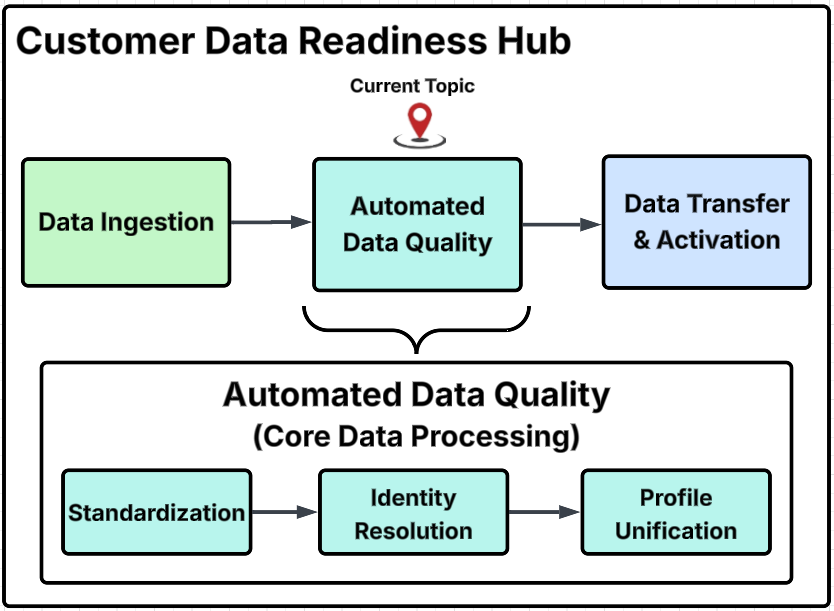
Customer Data Readiness Hub diagram
This diagram outlines the primary process steps within the Customer Data Readiness Hub, provides a detailed breakdown of specific activities within each major group, and identifies the particular step addressed on this page with the "Current Topic" marker.
Capability stack
-
Ingestion & quality: Standardization, parsing, validation, and normalization of names, phones, emails, addresses, and IDs.
-
Identity graph: Links people, households, devices, accounts, and events.
-
Matching & scoring: Deterministic keys plus configurable fuzzy rules (weights, thresholds, tie-breakers, negative rules).
-
Golden Record & survivorship: Attribute-level precedence, data lineage, and steward controls.
-
Consent & policy layer: Preference and purpose binding, audit trails, and region-specific constraints.
-
Real-time recognition: Edge APIs/SDKs for live customer recognition.
-
Activation & analytics: Segment and orchestrate in Redpoint Interaction; expose Golden Records and diagnostics to downstream tools.
Our guiding principles
-
Identity at the core: Quality is fundamentally assessed at the entity level, which includes individuals, households, and accounts. Identity resolution ensures that every signal is accurately connected to the appropriate entity. This connection produces a view that is accurate, complete, and up-to-date, enhancing data integrity.
-
Inline quality (shift-left): The principle of inline quality, often referred to as the "shift-left" approach, emphasizes the importance of maintaining data hygiene, standardization, validation, and normalization right at the point of data entry into the ecosystem. Addressing these quality measures proactively prevents the downstream accumulation of errors, which can lead to significant complications later on. This approach ensures that data remains clean and reliable from the outset, thus safeguarding the integrity of the entire data lifecycle. Redpoint’s approach ensures that data quality issues are addressed as soon as they’re identified by holding non-conforming data for review and manual intervention as soon as it is identified, rather than letting it propagate further on through your data environment.
-
Golden Record as a product: The Golden Record is a continuously updated operational asset that serves multiple functions, being utilized by analytics, activation, and services teams alike. The Golden Record provides a unified view of customer data, allowing organizations to leverage this information effectively in their decision-making processes.
-
Governed, transparent, and measurable: A robust quality process is characterized by its configurability, auditability, and the ability to be monitored through key performance indicators (KPIs) such as accuracy, completeness, timeliness, and consistency. These processes are further enhanced by survivorship rules and lineage that can be clearly explained to business users. This level of governance ensures that data quality is not only maintained but also transparent and measurable, allowing organizations to make informed decisions based on reliable data. For more information on the features that support these processes, refer to docs.redpointglobal.com.
-
Real-time readiness: Profiles and decisions must reflect the most recent events, attributes, and consent from customers. This real-time readiness ensures that customer experiences remain aligned with their current status and preferences, enhancing the effectiveness of customer engagement strategies.
What “good” looks like (outcomes we target)
-
A single, trusted profile is a unified view of customer data (Golden Record) made available at every touchpoint to enhance customer interactions and improve overall service delivery.
-
High match rates minimize waste and prevent duplicate outreach efforts so you can effectively engage with customers without redundancy, optimizing marketing and communication strategies.
-
Operational SLAs guarantee the freshness of data and the speed of response, exemplified by features such as millisecond profiles that enable organizations to determine the next-best action for customer engagement.
-
Auditability allows organizations to track how an attribute was derived, including its lineage and survivorship, as well as when it was last validated. This transparency is essential for maintaining data integrity and trustworthiness.
Quality controls mapped to Redpoint capabilities
|
Quality need |
What it solves |
Redpoint capability |
|---|---|---|
|
Standardization & validation |
Normalizes addresses, names, phones; raises deliverability |
Address Standardization, CASS reports, validation tools in Data Management. |
|
De-duplication & linking |
Removes duplicates; connects touchpoints to the right entity |
Identity Resolution rules (deterministic/probabilistic), candidate grouping, Golden Record creation. Refer also to the Hygiene, Matching, and Identity Resolution topic. |
|
Completeness & enrichment |
Fills gaps to enable segmentation/ML |
Enrichment steps in Data Management pipelines and connectors. |
|
Timeliness/freshness |
Keeps the profile in sync with events |
Real-time profile updates and event processing. |
|
Lineage & explainability |
Trust in attributes and decisions |
Visual pipelines, survivorship rules, auditability in Data Management. |
Operating model & best practices
-
Quality-by-design: Define data contracts and establish validation rules prior to the onboarding of any data sources; this enforcement should take place at the point of data ingress to ensure that the quality of data is maintained from the very beginning of the process.
-
Match policy playbooks: Begin with a deterministic approach by using exact keys for matching. Once this foundation is set, you can gradually expand the matching process to include fuzzy or probabilistic rules. Continuously monitor the rates of false positives and false negatives to check the effectiveness of the matching strategy.
-
Survivorship governance: Implement attribute-level rules that take into account factors such as source trust, recency, and completeness. These rules should be established with the necessary business sign-off to ensure alignment with organizational standards and expectations.
-
Closed-loop feedback: Push activation results, including metrics such as bounces, conversions, and dispositions, back to the profile. This feedback loop improves match logic and enhances quality KPIs, thereby optimizing overall performance.
-
Real-time where it matters: Reserve real-time updates to identity data for critical moments that could influence the next-best action. For other scenarios, such as heavy backfills, it is advisable to maintain a batch processing approach. This strategy ensures that resources are utilized efficiently while still allowing for timely updates when necessary.
Where this shows up in results
-
Achieve higher match rates and conversion lift through the implementation of accurate identity resolution techniques and the creation of unified profiles.
-
Reduced media and message waste is a result of suppressing duplicate entries and honoring customer consent, all derived from a single source of truth.
-
Faster activation of marketing strategies is made possible with the use of an always-ready, real-time profile, allowing you to respond swiftly to customer interactions and market changes.
Redpoint components that power data quality
-
Customer Data Readiness Hub / Data Management: Helps you to connect, standardize, validate, enrich, and ultimately create the Golden Record at scale, ensuring that data is not only accurate but also readily accessible and actionable.
-
Identity Resolution: Provides configurable matching capabilities that allow you to effectively identify and connect data across individuals, households, and accounts. It includes the ability to stitch together anonymous data into known identities, thereby enhancing the understanding of customer interactions.
-
Smart Engagement / Real-Time Interactions: Ensures that customer profiles remain current and actionable, so you can deliver the next-best experiences to your users in real time, adapting to their needs and preferences as they evolve.