

Introduction
Segmentation is the dynamic, data-driven grouping of customers for personalized engagement, built on the Golden Record and leveraging behavioral, demographic, transactional, and contextual data. It is the foundation of personalized, relevant, and timely customer engagement. Redpoint advocates for segmentation to evolve beyond static lists and one-dimensional audience splits; it should adapt to the changing context of the customer.
Segmentation is a critical aspect of the Redpoint CDP (Customer Data Platform) and Redpoint Interaction (RPI). The approach emphasizes unifying, activating, and optimizing customer data at scale. This ensures that every interaction with customers reflects a comprehensive understanding of the individual.
The segmentation process is designed to create a more personalized experience for customers by leveraging data insights. By effectively segmenting customer data, businesses can tailor their marketing strategies and interactions, leading to improved engagement and satisfaction. Redpoint's tools enable organizations to analyze customer behavior and preferences, allowing for dynamic segmentation that adapts to changing customer needs.
Overall, the philosophy around segmentation within Redpoint CDP and RPI is centered on enhancing customer relationships through data-driven insights, ensuring that every touchpoint is relevant and meaningful.
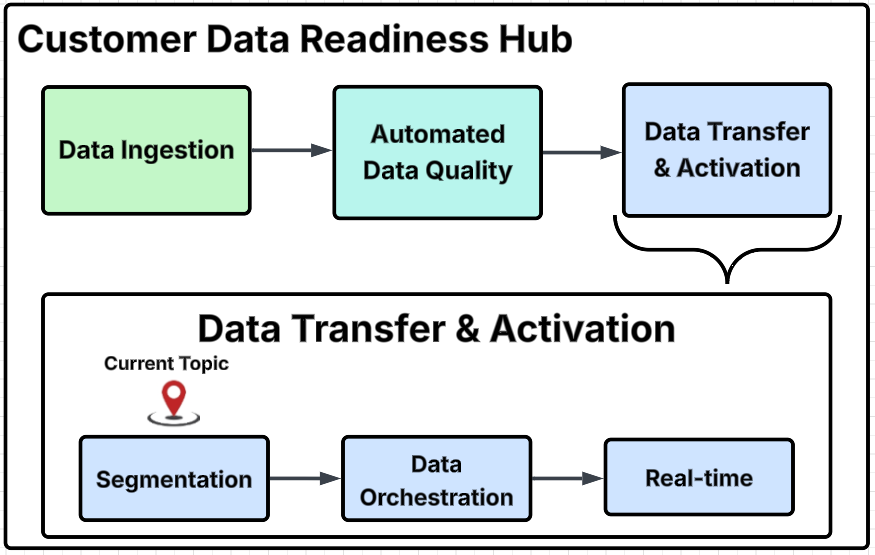
Customer Data Readiness Hub diagram
This diagram outlines the primary process steps within the Customer Data Readiness Hub, provides a detailed breakdown of specific activities within each major group, and identifies the particular step addressed on this page with the "Current Topic" marker.
Core tenets of Redpoint’s segmentation philosophy
Customer-centricity
Segmentation begins with the Golden Record — a comprehensive and unified view of each customer, meticulously compiled from all available data sources. This critical foundation eliminates data silos, ensuring that every audience segment is constructed from a consistent and reliable base. By creating a Golden Record, organizations can achieve a holistic understanding of their customers, which is essential for effective segmentation.
Every segment derived from this unified view is not merely a fragment or a snapshot of customer interaction; rather, it is an extension of the complete customer profile. This means that each segment reflects a deeper, more nuanced understanding of customer behaviors, preferences, and needs. By leveraging the Golden Record, businesses can tailor their marketing strategies and communications to resonate more effectively with each audience, ultimately driving engagement and fostering loyalty.
In essence, the Golden Record serves as the backbone of customer segmentation, enabling organizations to move beyond traditional methods that often rely on incomplete or outdated information. With a solid foundation in place, companies can create targeted campaigns that speak directly to the interests and motivations of their customers, leading to more successful outcomes and a stronger connection between the brand and its audience.
Precision and flexibility
Segmentation is a crucial aspect of marketing strategies, as it must provide marketers and analysts with the capability to operate at various levels of granularity. This ranges from broad audience groups that encompass large segments of the market to hyper-personalized one-to-one segments that cater to the unique preferences and behaviors of individual consumers. RPI enables marketers to effectively tailor their approaches based on the specific needs and characteristics of different audience segments. This flexibility allows for a more nuanced understanding of the market and enhances the ability to engage with customers in a meaningful way.
-
Flexible rule-building allows users to create both basic and advanced logic structures that can be tailored to meet specific needs and requirements. This flexibility ensures that users can adapt their rules to various scenarios, enhancing the overall effectiveness of their systems.
-
Behavioral, demographic, transactional, and contextual data inputs provide a comprehensive understanding of user interactions and preferences. By integrating these diverse data inputs, organizations can gain valuable insights that inform decision-making and strategy development.
-
Parameterized and reusable filters are designed to promote efficiency and standardization across processes. These filters enable users to create parameters that can be applied consistently, reducing redundancy and streamlining workflows while maintaining high levels of accuracy and reliability in data handling.
Agility and iteration
Markets and customers are in a constant state of flux, necessitating that segmentation strategies evolve in real time. RPI empowers teams to navigate this dynamic landscape effectively by offering a suite of tools and methodologies designed to enhance audience engagement and campaign performance.
-
RPI facilitates the rapid design, testing, and refinement of audience segments: This iterative process ensures that the segments created are not only relevant but also tailored to meet the ever-changing needs of the audience. Teams can create targeted segments that are flexible, allowing for adjustments and improvements based on real-time feedback and performance metrics. This responsiveness is crucial in a market where consumer preferences can shift overnight.
-
RPI emphasizes the importance of validation before launching campaigns: By utilizing audience snapshots and seeds, teams can confirm that their segments are accurately targeting the intended demographics. This validation step is essential for minimizing errors and maximizing the effectiveness of marketing campaigns. It ensures that resources are allocated efficiently and that the messaging resonates with the right audience, ultimately leading to higher engagement rates and better conversion outcomes.
-
RPI refreshes segments dynamically as new data enters the ecosystem: This real-time adjustment allows teams to stay ahead of trends and shifts in audience behavior and preferences. By continuously updating segments based on the latest insights, organizations can maintain relevance in their marketing strategies, ensuring that they engage their audience effectively. This adaptability is not just beneficial; it is key to maintaining customer engagement and achieving optimal results in an increasingly competitive marketplace.
In summary, RPI equips teams with the necessary tools to adapt to the fast-paced changes in markets and customer behavior. By focusing on rapid design and testing, validation of audience segments, and dynamic refreshing of data, RPI ensures that marketing strategies remain effective and relevant, ultimately driving better business outcomes.
Transparency and governance
Segmentation is not valuable if it cannot be trusted. Redpoint emphasizes:
-
Clear lineage and auditability means that every audience can be traced back to its underlying logic, the source from which it originates, and the individual or entity that created it. This traceability not only enhances transparency but also fosters trust among stakeholders who rely on this information.
-
Governance standards are put in place to effectively prevent issues such as duplication, inconsistencies, and potential compliance risks that could arise in various processes. By adhering to these standards, organizations can maintain a high level of integrity and reliability in their operations, ensuring that all data and information are managed appropriately.
-
Documentation and reporting play a crucial role in ensuring accountability across teams. By maintaining thorough records and generating comprehensive reports, organizations can track progress, evaluate performance, and hold individuals and teams accountable for their contributions and outcomes. This practice not only improves operational efficiency but also supports a culture of responsibility within the organization.
Personalization at scale
Segmentation is not the end goal; it is the bridge to personalization. RPI’s segmentation philosophy enables:
-
Consistent targeting across inbound and outbound channels ensures that messaging and promotional efforts are aligned, regardless of whether they are reaching potential customers through direct outreach or through passive engagement methods. By maintaining a unified strategy across these various channels, businesses can enhance their overall marketing effectiveness and improve customer engagement.
-
Dynamic orchestration of next-best actions allows organizations to respond to customer interactions in real-time. This capability involves analyzing customer behavior and preferences to determine the most effective subsequent steps in their journey. By leveraging data-driven insights, companies can tailor their responses and recommendations, ensuring that each interaction is relevant and timely, ultimately leading to higher conversion rates.
-
The ability to scale from campaigns to individual journeys without losing accuracy allows organizations to manage large-scale marketing campaigns while still providing personalized experiences for individual customers. By utilizing advanced analytics and automation tools, businesses can ensure that they deliver the right message to the right person at the right time, thus maximizing the impact of their marketing efforts and fostering stronger customer relationships.
Benefits of Redpoint’s segmentation approach
-
Relevance: The system is meticulously designed to deliver personalized experiences that resonate deeply with each individual customer. By leveraging advanced algorithms and customer insights, the platform ensures that the unique preferences and needs of every user are not only recognized but also addressed effectively. This tailored approach fosters a stronger connection between the brand and its customers, ultimately enhancing customer satisfaction and loyalty.
-
Efficiency: In an increasingly competitive market, time is of the essence. By implementing standardized and reusable segmentation processes, the platform significantly reduces the time-to-market for campaigns. This agility allows businesses to respond swiftly to market demands and trends, ensuring that they remain relevant and competitive. Moreover, the efficiency gained through these processes enables teams to focus on strategic initiatives rather than being bogged down by repetitive tasks.
-
Accuracy: The foundation of this innovative system is built on a unified, cleansed, and continuously updated dataset of customer information. This commitment to data integrity enhances the overall accuracy of insights and decisions made based on this data. By utilizing a robust dataset, businesses can make informed decisions that are reflective of current market conditions and customer behaviors, leading to more effective marketing strategies and improved outcomes.
-
Governance: In today’s data-driven world, compliance with regulatory standards is paramount. This solution not only supports adherence to necessary legal and ethical guidelines but also fosters operational trust among stakeholders. By ensuring that all data handling practices are transparent and responsible, businesses can build a reputation for reliability and integrity, which is crucial in maintaining customer trust and loyalty.
-
Future-readiness: The architecture of this system is designed to be adaptable, catering to both traditional batch campaigns and enabling real-time engagement. This flexibility prepares businesses for evolving marketing landscapes, allowing them to pivot and innovate as consumer preferences change. By being future-ready, organizations can capitalize on emerging opportunities and maintain a competitive edge in their respective industries.
Key features of selection and audience building
Flexible rule-building
Redpoint’s interface is designed with user-friendliness in mind, allowing users to build audiences through a highly intuitive drag-and-drop approach. This system empowers users to combine various data attributes with standard operators such as AND, OR, INCLUDE, and EXCLUDE, among others. The flexibility of this interface means that users are not limited to basic configurations; instead, they can create both fundamental and intricate logic structures. This capability allows for a high degree of customization, enabling users to tailor rules to meet specific business needs and scenarios, thus enhancing the effectiveness of their audience targeting strategies.
Multi-dimensional data inputs
Segmentation within Redpoint leverages an array of data inputs that include behavioral, demographic, transactional, and contextual information. This comprehensive approach provides a holistic view of each customer, allowing businesses to understand their audience on multiple levels. As a result, users can define audiences with fine granularity, ranging from broad segments that encompass large groups of individuals to hyper-personalized one-to-one targeting. This level of detail ensures that marketing efforts are not only relevant but also resonate with the intended audience, ultimately driving engagement and conversion rates.
Parameterized and reusable filters
The ability to parameterize filters and selection rules is a significant advantage within the Redpoint platform. By making these elements reusable across different audiences and campaigns, users can streamline their processes and enhance operational efficiency. This promotes a standardized approach to audience building, significantly reducing redundancy in workflows. As a result, marketers can focus more on strategy and less on repetitive tasks, leading to a more agile and responsive marketing environment. The reusability of these filters not only saves time but also ensures consistency in how audiences are defined and targeted across various campaigns.
Implementing an overall segmentation strategy
1. Foundation: The Golden Record
The foundation of effective segmentation begins with the Golden Record—a comprehensive, unified, and continuously updated customer profile that is meticulously compiled from all available data sources. This foundational element ensures that every segment is constructed from a consistent and reliable base, effectively eliminating data silos that can lead to fragmented insights. By supporting a holistic view of the customer, the Golden Record plays a crucial role in enabling targeted marketing efforts and enhancing customer engagement.
2. Defining segments and prioritization
To initiate the segmentation process, it is essential to start with your target universe, which may encompass all Golden Records. From this broad base, you can define primary segments that reflect your business objectives. For instance, segments might include categories such as prospect, active customer, lapsing, and win-back. These classifications should be based on specific business rules, which could involve factors like purchase history or engagement recency. By utilizing audience snapshots, you can effectively persist these segments, leading to improved performance and consistency. This approach avoids the need for repeated complex queries, streamlining the process of audience management.
3. Audience snapshots
Audience snapshots store the results of segmentation logic within a data warehouse table, which can be refreshed on a scheduled basis—daily or weekly, for example. These tables create attributes and joins that facilitate highly performant selection rules for future campaigns. The utility of snapshots is particularly pronounced when dealing with complex or frequently reused audiences, as they ensure that targeting remains up-to-date without placing undue strain on the database. This efficiency is crucial for maintaining optimal performance in marketing operations.
4. Channel and touchpoint eligibility
Once segmentation is established based on life cycle or other relevant criteria, it is important to layer in channel eligibility. This means determining which channels, such as email or SMS, are appropriate for each audience segment. You can choose to treat these channels as separate audiences or combine them as needed. Prioritizing channels based on established business rules—such as favoring email over SMS—can enhance the effectiveness of your outreach. Additionally, allowing for multi-channel eligibility can provide flexibility and improve overall customer engagement.
5. Campaign prioritization and journey design
For each defined segment, design a tailored journey that incorporates multiple touchpoints. For example, lapsing customers may benefit from a series of targeted communications designed to re-engage them. To prevent over-contacting customers, implement suppressions and metadata. For example, you might suppress communications for those who have received a message within the last 90 days. Each touchpoint can be managed as a distinct audience or interaction, complete with eligibility windows and suppression logic to control the cadence of communications. This thoughtful design ensures that customers receive relevant and timely messages without feeling overwhelmed.
6. Placeholders for reusability
Placeholders allow marketers to create selection rules with variables that can be overridden in different audiences or interactions. This approach eliminates the need to duplicate rules for each scenario, significantly reducing the number of objects within the system. Moreover, it ensures consistency across various journeys and touchpoints. For example, you might use a placeholder for “days since last purchase” and adjust its value for different campaigns or touchpoints. This level of reusability not only streamlines the process but also enhances the agility of marketing strategies, allowing for quick adaptations to changing customer needs and behaviors.
Best practices
-
Validate segments: Use audience snapshots and seeds to confirm that the segments you are targeting align with the intended demographics. This validation process should be conducted before launching any campaigns to ensure that your marketing efforts are directed towards the right audience. By taking the time to validate your segments, you increase the likelihood of achieving successful engagement and conversion rates, ultimately enhancing the effectiveness of your campaigns.
-
Iterate and refresh: Continuously update your segments as new data becomes available. Regularly iterating and refreshing your segments ensures that your targeting remains relevant and adapts to the changing preferences and behaviors of your audience. This proactive approach not only helps in maintaining engagement but also allows for more precise targeting, which can lead to improved campaign performance and customer satisfaction.
-
Governance and transparency: Maintaining clear lineage, auditability, and comprehensive documentation for all segments and selection rules helps build trust within your organization and with your audience. By ensuring that there is a clear record of how segments are created and modified, you can facilitate better decision-making and accountability, as well as streamline compliance with any regulatory requirements that may apply to your marketing practices.
-
Personalization at scale: Leveraging segmentation effectively enables you to deliver personalized experiences across all channels and touchpoints. By understanding the unique characteristics and preferences of different segments, you can tailor your messaging and offers to resonate more deeply with your audience, ensuring that each interaction feels relevant and meaningful to the customer. This level of personalization not only enhances customer engagement but also fosters loyalty and long-term relationships, ultimately driving better business outcomes.
Example workflow
-
Start with all available Golden Records to ensure a comprehensive foundation for your audience segmentation.
-
Apply necessary suppressions to filter out individuals who are deceased or flagged for fraud, ensuring that your data remains clean and relevant.
-
Segment the audience into distinct categories, such as active, lapsing, and win-back, to tailor your marketing strategies effectively.
-
Create an Audience Snapshot for each segment, providing a clear overview of the characteristics and behaviors of each group.
-
Layer channel eligibility by assigning appropriate communication methods, such as email or SMS, to each segment based on their preferences and past interactions.
-
Define the customer journeys and touchpoints for each segment, incorporating the suppressions and eligibility windows to optimize engagement.
-
Utilize placeholders in your campaigns to streamline rule management, making it easier to implement changes and maintain consistency across different marketing efforts.
-
Schedule regular snapshot refreshes to ensure that your data remains current and reflective of any changes in your audience.
-
Continuously monitor and iterate on your strategies based on campaign results and feedback, allowing for ongoing improvement and adaptation to audience needs.
By leveraging these advanced features and implementing best practices, you can craft a segmentation strategy that is not only robust and scalable but also agile enough to adapt to changing market dynamics. This strategy will support the dynamic building of audiences, allowing for more targeted and effective marketing efforts.
In addition, it will facilitate efficient campaign execution, ensuring that your marketing initiatives are timely and relevant. The ultimate goal is to achieve true personalization at scale, which means delivering tailored experiences to each individual within your audience. This approach not only enhances customer engagement but also drives higher conversion rates, ultimately leading to increased loyalty and satisfaction among your customers.
Conclusion
Redpoint views segmentation as a strategic enabler of customer engagement rather than a one-off step in campaign execution. By unifying customer data, applying precise rules, and ensuring governance and transparency, RPI delivers segmentation that drives personalization at scale. This approach empowers organizations to connect with customers effectively, delivering the right message at the right time and fostering stronger relationships and measurable business growth.
Refer to the following documentation for detailed information about Redpoint’s implementation of segmentation:
-
Information about the preconfigured campaign templates as a part of CDP: Campaign template details and configuration