
Introduction
Profile unification is the end-to-end process of ingesting, standardizing, matching, merging, and governing customer data to create persistent, activation-ready profiles (e.g., Individual, Household, Customer, Loyalty, Member). Data standardization and identity resolution serve as foundational steps leading to a cohesive understanding of user profiles. This page explores Redpoint’s perspective on profile unification, illustrating how it integrates with the broader strategy of creating Golden Records, the unified and accurate representation of individual identities.
Profile unification & Golden Record creation
Redpoint helps you curate customer data into clear, accurate profiles that fuel personalization, improve performance, and keep your teams focused on what matters. Below are the details on Redpoint’s philosophy on profile unification.
Customer Data Readiness Hub diagram
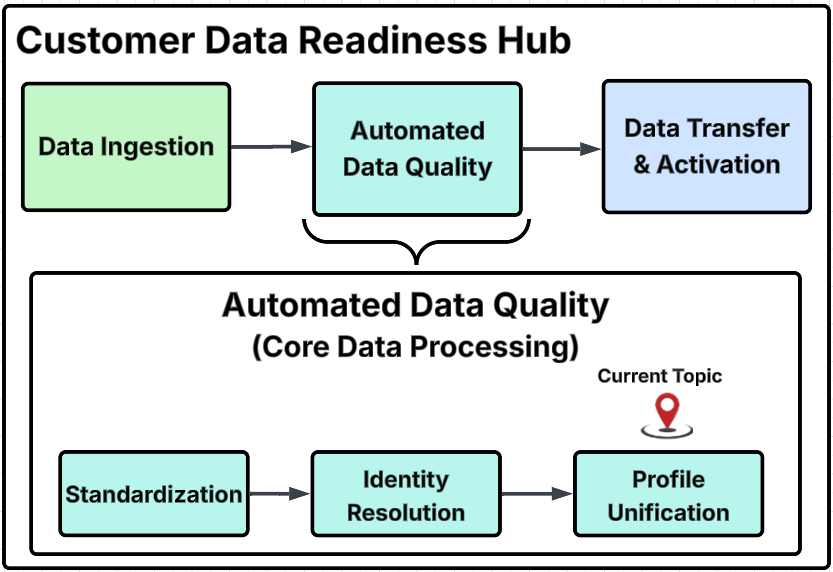
This diagram outlines the primary process steps within the Customer Data Readiness Hub, provides a detailed breakdown of specific activities within each major group, and identifies the particular step addressed on this page with the "Current Topic" marker.
Summary
Redpoint treats identity as a living asset that powers every customer interaction. Our philosophy centers on three principles:
-
Trust by design: Build unified profiles and Golden Records from standardized, governed, and fully auditable data.
-
Fit for activation: Optimize unification for downstream use (analytics, orchestration, personalization).
-
Continuous reconciliation: Identity evolves; systems must support regular and consistent updates, reversible decisions (unmerge), and transparent lineage.
The outcome is a unified profile (Golden Record) that is accurate, complete, and activation-ready, linking PII, channel identifiers, consent, preferences, and predictive attributes across time.
Unified profile definition and generation
A unified profile is a comprehensive, consolidated view of an individual, created by linking and summarizing disparate data sources using personally identifiable information (PII) and other keys. Identity resolution assigns a unique identifier to each individual, matching records across systems to determine if they refer to the same or different persons. Once linked, the data is rolled up into various unified profiles, such as an individual (Golden Record), customer, or loyalty account profile, depending on the needs of downstream activities like campaign orchestration or data analytics.
To generate a unified profile, records from multiple data sources are associated with a single individual ID. Rules are configured to determine the “best” PII element to represent each individual, ensuring accurate and consistent identification. This process enables the summarization of all related transactions and activities under one profile, providing a true picture of engagement with an organization.
Unified profiles unlock value by making linked data actionable for downstream systems, supporting use cases such as matching multiple customer accounts to one individual, or connecting loyalty activities that occur across different channels. The type of profile needed is driven by the intended data activation, with tailored profiles created to meet specific business requirements. Additionally, unified profiles provide linkage to metadata surrounding customers and their behaviors, enhancing the ability to analyze and understand customer interactions across various touchpoints. This metadata can include information such as purchase history, engagement levels, and preferences, which further enriches the profile and enables more personalized and effective marketing strategies.
A unified profile transforms fragmented data into an organized, actionable summary about an individual, laying the foundation for precise customer insights and effective business strategies.
Sample profile types
-
Individual (Golden Record): This is a unified profile at the individual level which will select the PII based on defined rules to select the “best” PII out of all the available values. For example, when two customer records match, there could potentially be multiple values for email to select from; make a unified profile by selecting the best email based on something like most recently provided.
-
Household: This profile provides a unified view of the household and rolls up data based on the household ID. This can be used to send a single direct mail piece to a household vs. to multiple individuals in the same household.
-
Customer: This provides a unique view of the customer's behavior for a specific customer ID vs. rolling up at the individual ID, where that could be summarizing data across multiple customer accounts for the same individual.
-
Loyalty: This provides a unified profile at the loyalty level vs. rolling up at the individual level, which could go across multiple loyalty accounts. You could use a profile like this would to send out monthly loyalty statements with points balance and other information related to each loyalty account and not the individual, which may have multiple accounts.
-
Member: A member of an insurance company may have multiple policies for the same individual, but you need to maintain consent and preferences based on the settings for the member level and not at the individual level, as that may make communication permissions too loose or tight for a given member, which is not a compliant way to communicate.
Privacy, compliance & governance
When unifying data into a profile, consider the governance, privacy, and compliance implications. Here are some key points to keep in mind:
-
Privacy: Consider whether the data in question meets the necessary privacy requirements that govern its use. Ensure that all preferences are being accurately associated with the corresponding profile. This means that any individual’s privacy choices should be respected and properly reflected in how their data is managed and utilized.
-
Compliance: Evaluate whether you have established profiles that can effectively support the communications required for compliance-related matters. Having profiles at the customer level is particularly beneficial, as it allows for the sending of messages to each customer regarding their accounts. This approach is more effective than aggregating communications at an individual level, which may lead to a lack of clarity or personalization in the messages being sent.
-
Governance: Assess whether the standardization of data and its stewardship contribute to building profiles that are both accurate and reliable. Effective governance in this context ensures that the data is not only well-managed but also inspires confidence among stakeholders, thereby facilitating better decision-making processes based on the quality of the profiles created.
Redpoint summaries
The summaries below illustrate examples of summary tables that create a unified profile for segmentation and activation. These tables are predefined based on a standard data model for the source data. You can adapt them to fit your data model or modify them to meet your calculation needs.
-
https://docs.redpointglobal.com/bpd/individual-golden-record-summary
-
https://docs.redpointglobal.com/bpd/individual-golden-record-summary-pii
-
https://docs.redpointglobal.com/bpd/customer-account-bu-summary
-
https://docs.redpointglobal.com/bpd/loyalty-account-bu-summary
-
https://docs.redpointglobal.com/bpd/individual-bu-email-summary
Next topic
Now that you have a Golden Record or other unified profiles you can move on to segmentation and data orchestration.