

Overview
The Assign Groups dialog, displayed on invocation of Choose Groups at the Users list in the Client tab, allows you to manage the assignment of user groups to the currently selected user, in the context of the currently selected client. This last point is significant, as a given user may have access to more than one client but perform different roles in each.
The list of user groups made available in the dialog is, by default, limited to the Everyone and System Administrators groups created at client installation. In addition, any custom groups created manually in the User Groups administration interface in the RPI client application are also displayed.
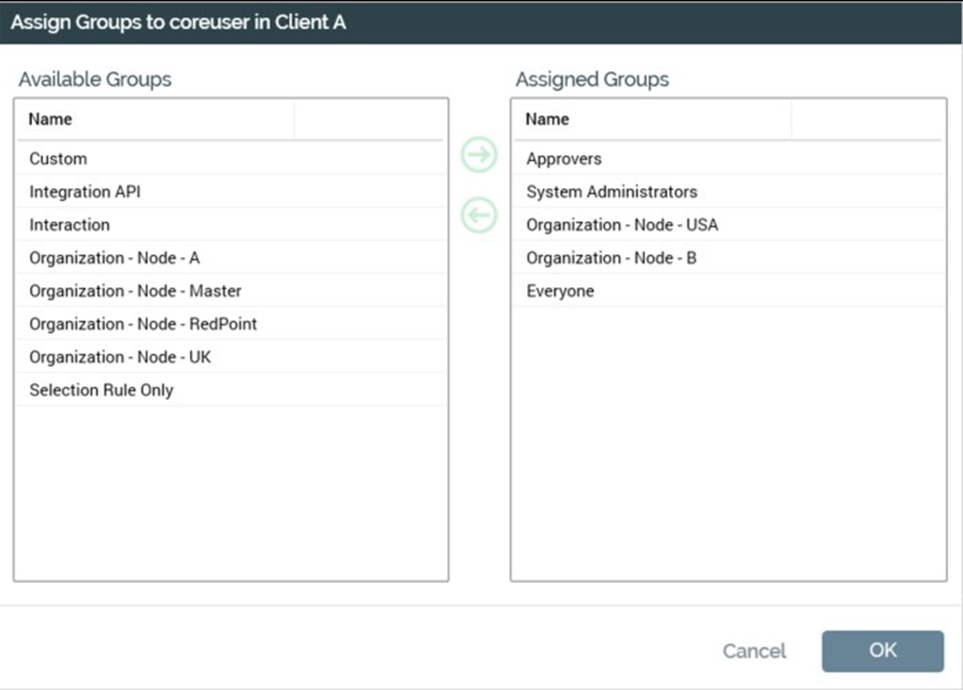
On invocation, the dialog presents two lists of user groups: to the left, a list of those user groups that are not currently assigned to the selected user in the current context; and to the right, a list of those already assigned. On initial display, the contents of the two lists reflect the current state of user group assignment at the user in the context of the current client.
Available Groups Section
The list to the left displays user groups that have not yet been associated with the current user. Groups are listed alphabetically. A single property (Name) is shown.
User Groups Buttons
Two buttons, shown between the two lists, control the assignment of user groups to, and removal of user groups from, the current user:
-
Assign the selected Groups to this User: this button is enabled when one or more user groups are selected in the Available Groups grid. Invocation moves the groups to the Assigned Groups grid.
-
Remove the selected Groups from this User: this button is enabled when one or more user groups are selected in the Assigned Groups grid. Invocation moves the groups to the Available Groups grid. Note that you cannot remove the Everyone group from a user.
Note also that double-clicking a group in either list has the effect of removing the group from that list and moving it to the other list.
Assigned Groups Section
The list to the right displays user groups that have been associated with the current user in the context of the current client. Groups are listed alphabetically. A single property (Name) is shown.
OK and Cancel
Clicking the OK button at the bottom of the dialog closes the dialog, and immediately saves any changes made therein to the core operational database (note the difference in behavior from the Assign Users dialog).
Clicking Cancel closes the dialog without saving.